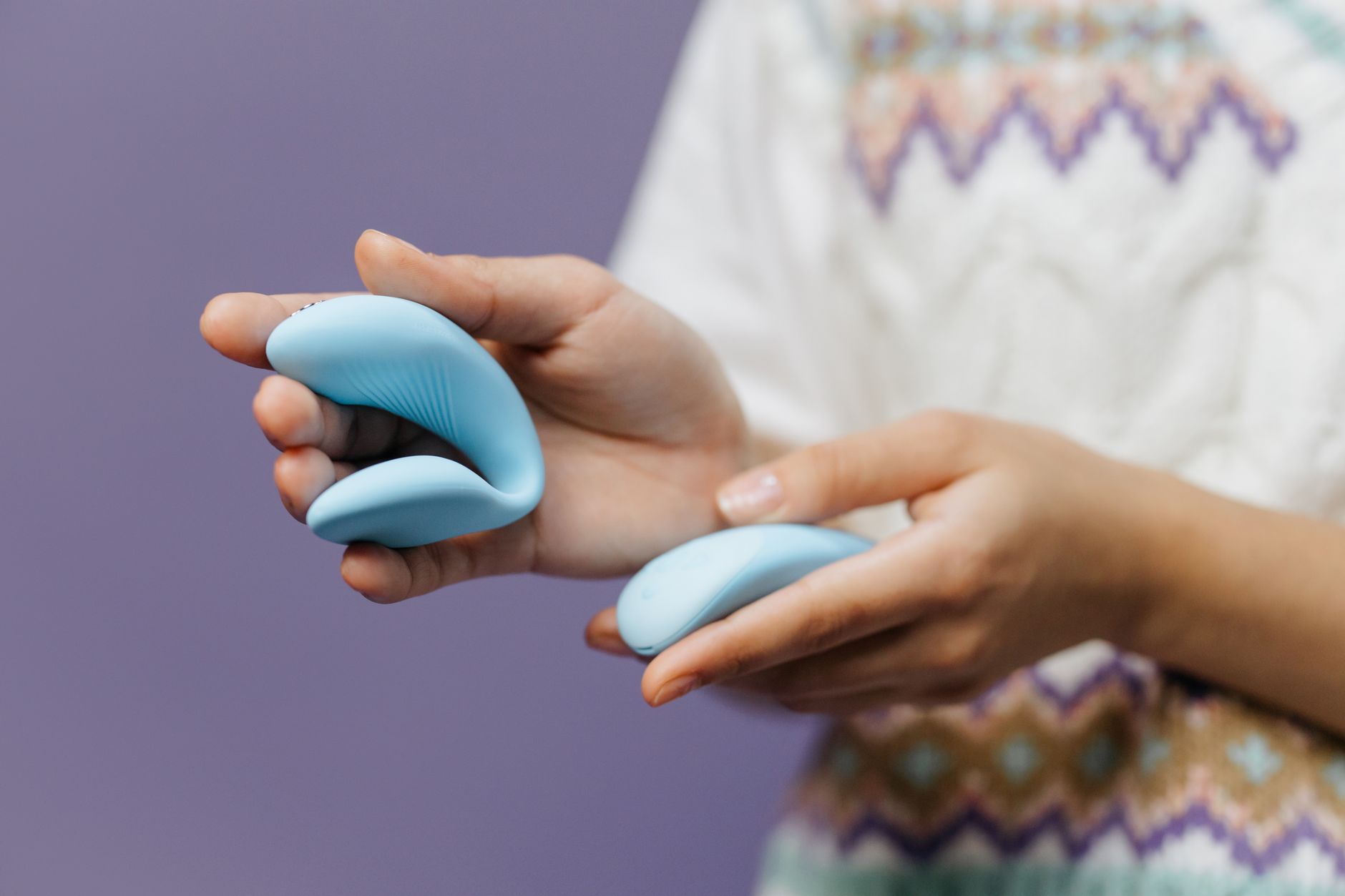
Let's name the thing nobody talks about
You can orgasm alone. Sometimes easily. But the moment another person is involved, your nervous system does something weird. The path that worked perfectly solo suddenly feels blocked. You're not broken. This is one of the most common sexual experiences among partnered people, and it has a name: arousal non-concordance. Your body isn't cooperating because your body is working exactly as it should.
The lemon vibrator changes the equation. But only if you use it as a tool for connection, not a bandage for shame.
Why partnered sex feels different in your nervous system
When you're solo, you control everything. Pressure, speed, angle, timing, the exact micro-moment you shift from building to climaxing. Your autonomic nervous system gets to stay settled.
With a partner, a thousand micro-stressors activate. Are they losing interest? Am I taking too long? Should I fake it? Is my body doing the right thing? Do they feel adequate? These thoughts don't have to be conscious to hijack your arousal.
Research in sexual medicine calls this the "spectatoring effect." Your brain splits into two. One part is feeling pleasure, and one part is watching and judging the person providing it. The watcher always wins.
A clitoral vibrator doesn't erase these thoughts. But it does something more useful. It gives your brain a job that requires presence. You can't watch yourself orgasm while you're focused on the sensation of suction and vibration building in real time.
The conversation that has to happen first
Before you introduce a lemon vibrator into partnered sex, you and your partner need a ten-minute conversation. Not a heated negotiation. A conversation.
Say something like: "I want us to explore something together that might help me get there more consistently. I think it could feel good for both of us, but I need to know you're interested before we try it."
Then listen. If they immediately say yes, great. If they hesitate, ask why. The hesitation might be practical (they're worried about mess, or they think it means they're not enough), or it might be deeper (they feel rejected, they're nervous about change). These are different conversations that need different responses.
The most common partner worry is "Does this mean I'm not satisfying you?" The honest answer is: this is not about adequacy. It's about nervous system wiring. A person can be wildly attracted to their partner and still need external input to reach orgasm during sex. These two facts coexist.
How to actually introduce the lemon vibrator during sex
Do not make your first time a performance moment. Do not do this when you're already midway through sex and stressed.
Start in a low-stakes situation. Maybe you're both naked, you're kissing, there's no expectation yet. Pull it out then. Let them hold it, feel the weight, see how it works. Some partners feel better about devices when they understand the mechanics.
Then, here's the exact sequence that works:
-
Start with your partner inside you (or entering you) while you apply the vibrator to your clitoris. The suction sensation plus internal stimulation creates a whole different intensity.
-
You control the vibrator. Not your partner. You decide the pattern, the intensity, the rhythm. Your partner's job is to stay present and adjust based on what feels good for you.
-
If you want to build to orgasm this way, let yourself. Don't rush it, don't perform, just chase the feeling.
Some people orgasm within minutes. Some people take longer. The point is not to "achieve" orgasm on a timeline. The point is to feel what it's like to receive internal and external stimulation at the same time, with a partner, without the mental commentary.
Why the Lem works better than other lemon clitoral vibrators for this specific thing
The lemon vibrator's suction mechanism is different from standard vibrators. It doesn't vibrate in a line; it creates a gentle seal and pulse pattern. This matters during partnered sex because:
You don't need the same level of friction that you might solo. Penetration already provides stimulation. The Lem adds focused, rhythmic sensation without that drilling feeling that can feel overwhelming when someone's inside you.
The sensation is more localized to the clitoral head and glans. This means you're getting intense, specific feedback without the whole vulva feeling overstimulated.
It's quieter. Not silent, but quieter than a traditional vibrator. For some couples, reducing that clinical buzzing noise makes the experience feel more intimate rather than tool-based.
Managing the mental stuff while you're doing this
Using any adult toy with a partner surfaces feelings you might not expect. Here's what usually comes up:
Guilt ("I should be able to do this without help"). Not true. Your nervous system isn't a character flaw.
Pressure ("Now I have to orgasm because we set up the conditions"). The whole point is to release the outcome focus, not add pressure. If it doesn't happen this time, that's fine.
Nocturnal doubt ("Does my partner resent this?" or "Am I being selfish?"). Partners who feel secure usually feel the opposite. They feel trusted and included.
If any of these feelings surface mid-sex, pause and check in. "I'm getting in my head a bit. Can we slow down?" Your partner probably wants to know. They're not enjoying themselves if you're performing.
The second, third, and tenth times matter more than the first
The first time you use a lemon vibrator with your partner might be weird. You might feel self-conscious. Your partner might find it takes them longer to finish. These things usually smooth out by the third or fourth time.
What changes is familiarity. It stops being a novelty and becomes part of your sexual repertoire. You get better at angling it. Your partner learns what patterns help you build. Your nervous system realizes there's no judgment happening. You can let the spectatoring brain relax.
After a few times, many couples report that using the lemon vibrator actually deepens connection. You're collaborating toward the same goal. You're vulnerable in a new way. That creates intimacy that doesn't exist when someone's just hoping you'll get there eventually.
What to do if your partner is still resistant
If your partner continues to resist or refuses, that's worth exploring separately. Sometimes the resistance is about control. Sometimes it's about their own insecurity that has nothing to do with you. Sometimes it's about different attitudes toward sexuality.
None of those things get better with pressure. They get better with honest conversation, ideally with support from a couples therapist. A coach or counselor trained in sexual health can help you both move past the shame and into a more collaborative place.
If your partner is willing but hesitant, start even smaller. Let them see you use the lemon vibrator solo while they watch. Some partners feel less threatened when they understand your body's response without performing it for them.
What happens once this becomes normal
Many couples find that introducing external stimulation takes something off their shoulders. The pressure to be "enough" lifts. Sex stops being a performance and becomes a shared experience where you're both invested in your pleasure, not just their pleasure or some abstract version of "good" sex.
You might find that once you know you can reach orgasm with a partner, you sometimes don't need the vibrator. Your body relaxes into trust. Other times, you'll keep using it because it feels incredible. Both are fine.
The real win isn't the orgasm. It's the permission. Permission to know what you need, to ask for it, and to trust your partner enough to show them.
People also ask
Will using a lemon vibrator during sex make my partner feel inadequate?
Not if you talk about it first and not if they understand that the tool is helping your body relax into arousal, not replacing them. Partners who feel insecure benefit from hearing something like: "I want this because I feel safe with you and I want us to experience more sensation together." Many partners feel relieved when there's a concrete solution to difficulty reaching orgasm that felt inevitable before.
Can I use a lemon clitoral vibrator if my partner is inside me?
Yes. The best angle is usually with your partner entering from behind or with you on top, as this gives you the most control over placement and pressure. If you're facing each other, it can work but often requires some repositioning. Start by finding the position that feels least awkward and build from there.
What if I still can't orgasm even with the vibrator and my partner?
Then you might be dealing with something beyond nervous system arousal. Low desire, medication side effects, past trauma, or relationship stress can all block orgasm even with the right tools. This is a good time to talk to a therapist who specializes in sexual health or see your doctor to rule out medical factors.
How do I know what pattern on the lemon vibrator to use during partnered sex?
Start with pattern one or two (lower intensity) and experiment from there. Most people find that a mid-range pattern works best during penetration. You might use a higher pattern solo or a lower one with a partner. Your body will tell you what feels right if you give yourself permission to explore without judgment.
Is it normal to feel self-conscious using a vibrator with a partner for the first time?
Completely normal. You're being vulnerable in a new way and introducing something that can feel clinical or shame-laden if you grew up with any messaging that toys are taboo. The feeling usually fades once you realize your partner isn't judging you and once your body releases the spectatoring response.
What if my partner wants to use the lemon vibrator on me but I want to control it?
Say that. "I think I want to hold this one and figure out the right angle and pressure for my body right now." You can always trade control later once you've found what works. Many couples eventually both have a comfort level using it, but there's no rule that says you have to.
The bottom line
Difficulty reaching orgasm with a partner is not a personal failing. Your nervous system isn't broken; it's just wired in a way that requires specific input to relax into arousal when another person is involved. A lemon clitoral vibrator is a tool that can bridge that gap, but only if you approach it as a shared exploration, not a fix for something wrong with you. The real work is the conversation, the curiosity, and the willingness to show your partner what you actually need.